Synopsis
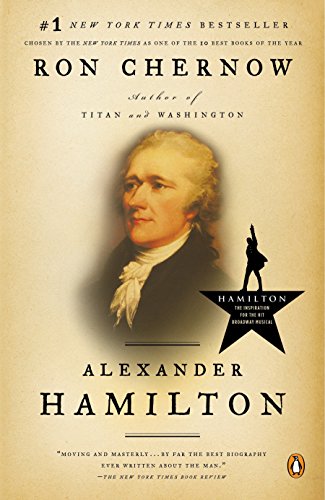
The #1 New York Times bestseller, and the inspiration for the hit Broadway musical Hamilton!
Pulitzer Prize-winning author Ron Chernow presents a landmark biography of Alexander Hamilton, the Founding Father who galvanized, inspired, scandalized, and shaped the newborn nation.
"synopsis" may belong to another edition of this title.
About the Author
Ron Chernow is the prizewinning author of seven books and the recipient of the 2015 National Humanities Medal. His first book, The House of Morgan, won the National Book Award; Washington: A Life won the Pulitzer Prize for Biography; and Alexander Hamilton--the inspiration for the Broadway musical--won the George Washington Book Prize. His other books include The Warburgs, The Death of the Banker, Titan, and Grant. A past president of PEN America, Chernow has been the recipient of eight honorary doctorates. He resides in Brooklyn, New York.
Excerpt. © Reprinted by permission. All rights reserved.
On the night of April 18, 1775, 800 British troops marched out of Boston to capture Samuel Adams and John Hancock and seize a stockpile of patriot munitions in Concord, Massachusetts. As they passed Lexington, they encountered a motley battalion of militia farmers known as Minutemen, and in the ensuing exchange of gunfire the British killed 8 colonists and then 2 more in Concord. As the redcoats retreated helter-skelter to Boston, they were riddled by sniper fire that erupted from behind hedges, stone walls, and fences, leaving a bloody trail of 273 British casualties versus 95 dead or wounded for the patriots.
The news reached New York within four days and a mood of insurrection promptly overtook the city. People gathered at taverns and street corners to ponder events while Tories quaked. The newly emboldened Sons of Liberty streamed down to the East River docks, pilfered ships bound for British troops in Boston, then emptied the city hall arsenal of its muskets, bayonets, and cartridge boxes, grabbing a thousand weapons in all.
Armed with this cache, volunteer militia companies sprang up overnight. However much the British might deride these ragtag citizen-soldiers, they conducted their business seriously. Inflamed by the astonishing news from Massachusetts, Alexander Hamilton, then a student at King’s College (later Columbia University), was that singular intellectual who picked up a musket as fast as a pen. Nicholas Fish recalled that “immediately after the Battle of Lexington, [Hamilton] attached himself to one of the uniform companies of militia then forming for the defence of the country by the patriotic young men of this city under the command of Captain Fleming.” Fish and Robert Troup, both classmates of Hamilton, were among the earnest cadre of King’s College volunteers who drilled before classes each morning in the churchyard of nearby St. Paul’s Chapel. The fledgling volunteer company was named the Hearts of Oak. The young recruits marched briskly past tombstones with the motto of “Liberty or Death” stitched across their round leather caps. On short, snug green jackets they also sported, for good measure, red tin hearts that announced “God and our Right.”
Hamilton approached this daily routine with the same perfectionist ardor that he exhibited in his studies. Troup stressed the “military spirit” infused into Hamilton and noted that he was “constant in his attendance and very ambitious of improvement.” Never one to fumble an opportunity, Hamilton embarked on a comprehensive military education. With his absorbent mind, he mastered infantry drills, pored over volumes on military tactics and learned the rudiments of gunnery and pyrotechnics from a veteran bombardier. There was a particular doggedness about this young man, as if he were already in training for something far beyond lowly infantry duty.
On April 24, a huge throng of patriots massed in front of city hall. While radicals grew giddy with excitement, many terrified Tory merchants began to book passage for England. The next day, an anonymous handbill blamed Myles Cooper, the Tory president of King’s College, and four other “obnoxious gentlemen” for patriotic deaths in Massachusetts and said the moment had passed for symbolic gestures. “The injury you have done to your country cannot admit of reparation,” these five loyalists were warned. “Fly for your lives or anticipate your doom by becoming your own executioners.” A defiant Myles Cooper stuck to his post.
After a demonstration on the night of May 10, hundreds of protesters, armed with clubs and heated by a heady brew of political rhetoric and strong drink, descended on King’s College, ready to inflict rough justice on Myles Cooper. Hercules Mulligan recalled that Cooper “was a Tory and an obnoxious man and the mob went to the college with the intention of tarring and feathering him or riding him upon a rail.” Nicholas Ogden, a King’s alumnus, saw the angry mob swarming toward the college and raced ahead to Cooper’s room, urging the president to scramble down a back window. Because Hamilton and Troup shared a room near Cooper’s quarters, Ogden also alerted them to the approaching mob. “Whereupon Hamilton instantly resolved to take his stand on the stairs [the outer stoop] in front of the Doctor’s apartment and there to detain the mob as long as he could by an harangue in order to gain the Doctor the more time for his escape,” Troup recorded.
After the mob knocked down the gate and surged toward the residence, Hamilton launched into an impassioned speech, telling the boisterous protesters that their conduct, instead of promoting their cause, would “disgrace and injure the glorious cause of liberty.” One account has the slightly deaf Cooper poking his head from an upper-story window and observing Hamilton gesticulating on the stoop below. He mistakenly thought that his pupil was inciting the crowd instead of pacifying them and shouted, “Don’t mind what he says. He’s crazy!” Another account has Cooper shouting at the ruffians: “Don’t believe anything Hamilton says. He’s a little fool!” The more plausible version is that Cooper had vanished, having scampered away in his nightgown once Ogden forewarned him of the approaching mob.
Hamilton knew he couldn’t stop the intruders but he won the vital minutes necessary for Cooper to clamber over a back fence and rush down to the Hudson. Of all the incidents in Hamilton’s early life in America, his spontaneous defense of Myles Cooper was probably the most telling. It showed that he could separate personal honor from political convictions and presaged a recurring theme of his career: the superiority of forgiveness over revenge. Most of all, the episode captured the contradictory impulses struggling inside this complex young man, an ardent revolutionary with a profound dread that popular sentiment would boil over into dangerous excess.
"About this title" may belong to another edition of this title.
Other Popular Editions of the Same Title

Search results for Alexander Hamilton

Seller Image
ALEXANDER HAMILTON
Seller: Austin Goodwill 1101, Austin, TX, U.S.A.
Seller rating 4 out of 5 stars

Condition: acceptable. Book shows noticeable wear from use. May include writing, highlighting, or other markings, but not excessive. Cover or edges may have visible wear. The book remains complete and fully readable. Seller Inventory # 4RZV6M000ZSX
Seller Image
Alexander Hamilton
Seller: Austin Goodwill 1101, Austin, TX, U.S.A.
Seller rating 4 out of 5 stars
Condition: good. Book shows general signs of use and handling. May have light wear on the cover or edges and minimal writing or highlighting. Binding remains tight, and pages are clean and readable. Seller Inventory # CTXV.0143034758.G
Stock Image
Alexander Hamilton
Published by
Penguin Putnam Inc, United States, New York, NY, 2005
ISBN 10: 0143034758
ISBN 13: 9780143034759
Used
Paperback
Seller: WorldofBooks, Goring-By-Sea, WS, United Kingdom
Seller rating 5 out of 5 stars

Paperback. Condition: Very Good. The book has been read, but is in excellent condition. Pages are intact and not marred by notes or highlighting. The spine remains undamaged. Seller Inventory # GOR002867245
Buy Used
£ 9.94
£ 6.02 shipping
Ships from United Kingdom to Hong Kong
Ships from United Kingdom to Hong Kong
Quantity: 1 available
Stock Image
Alexander Hamilton
Published by
Penguin Publishing Group, 2005
ISBN 10: 0143034758
ISBN 13: 9780143034759
Used
Softcover
Seller: Better World Books, Mishawaka, IN, U.S.A.
Seller rating 5 out of 5 stars
Condition: Good. Former library book; may include library markings. Used book that is in clean, average condition without any missing pages. Seller Inventory # 5977886-6
Stock Image
Alexander Hamilton
Published by
Penguin Publishing Group, 2005
ISBN 10: 0143034758
ISBN 13: 9780143034759
Used
Softcover
Seller: Better World Books, Mishawaka, IN, U.S.A.
Seller rating 5 out of 5 stars
Condition: Good. Used book that is in clean, average condition without any missing pages. Seller Inventory # 4777531-6
Buy Used
£ 5.38
£ 14.95 shipping
Ships from U.S.A. to Hong Kong
Ships from U.S.A. to Hong Kong
Quantity: Over 20 available
Stock Image
Alexander Hamilton
Published by
Penguin Publishing Group, 2005
ISBN 10: 0143034758
ISBN 13: 9780143034759
Used
Softcover
Seller: Better World Books: West, Reno, NV, U.S.A.
Seller rating 5 out of 5 stars
Condition: Good. Former library book; may include library markings. Used book that is in clean, average condition without any missing pages. Seller Inventory # 5977886-6
Stock Image
Alexander Hamilton
Published by
Penguin Publishing Group, 2005
ISBN 10: 0143034758
ISBN 13: 9780143034759
Used
Softcover
Seller: Better World Books: West, Reno, NV, U.S.A.
Seller rating 5 out of 5 stars
Condition: Good. Used book that is in clean, average condition without any missing pages. Seller Inventory # 4777531-6
Buy Used
£ 5.38
£ 14.95 shipping
Ships from U.S.A. to Hong Kong
Ships from U.S.A. to Hong Kong
Quantity: Over 20 available
Stock Image
Alexander Hamilton
Seller: Cathy's Half Price Books, Havertown, PA, U.S.A.
Seller rating 4 out of 5 stars
Paperback. Condition: Good. Shows some light wear from age and use. Interior is good with sound binding and no marks, damage or labels. We Ship Daily! Satisfaction Guaranteed! Seller Inventory # 175749
Stock Image
Alexander Hamilton
Seller: Bookmans, Tucson, AZ, U.S.A.
Seller rating 5 out of 5 stars
Paperback. Condition: Good. Satisfaction 100% guaranteed. Seller Inventory # mon0001450705
Stock Image
Alexander Hamilton
Seller: JR Books, Grand Rapids, MI, U.S.A.
Seller rating 2 out of 5 stars

paperback. Condition: LikeNew. Fast Shipping - Safe and Secure Bubble Mailer! Seller Inventory # 53KWVC000C69